
Welcome Guide
Welcome to CashFlowAlign™
A practical cash-flow management system designed to organize your money, automate your priorities, and make everyday spending easier to manage.
A Better Way to Manage Cash Flow
Traditional budgets often fail because they are too complicated to maintain and too disconnected from real life. They ask you to track every purchase, manage dozens of categories, and constantly compare what you planned to spend with what actually happened.
Before long, budgeting begins to feel restrictive, time-consuming, and judgmental. An irregular expense can make the entire month look like a failure. The balance in your checking account may not match what the budget says should be available. Falling behind on categorizing a few transactions can make the entire system feel outdated.
Eventually, many people stop using the budget altogether. The problem is not necessarily a lack of discipline. Most traditional budgeting systems simply require too much ongoing effort and do not reflect how money actually moves through a household.
Why CashFlowAlign™ Works Better
CashFlowAlign™ brings together three things traditional budgets often treat separately: planning, spending, and cash-flow timing. The result is a system that is easier to follow, more realistic, and more useful in everyday life.
Give Every Account a Clear Purpose
Income flows into the Operating checking account. Saving, investing, debt payments, fixed bills, and other planned transfers are paid from that account. Each week, a predetermined amount is transferred from Operating checking into a separate Weekly Spending Checking Account. Everyday variable expenses are then paid directly from that account using its associated debit card.
This creates a clear distinction between money already committed, money reserved for important priorities, and money that is genuinely available to spend.
See When Money Moves, Not Just Where It Goes
Having enough income for the month does not always mean the timing works. CashFlowAlign™ creates a projected Operating checking timeline showing when income arrives, when bills and debt payments clear, when saving and investment transfers occur, when Weekly Spending transfers leave, and the projected balance after each transaction.
Protect Your Operating Cushion
The balance shown in checking is not always the amount available to spend. Some of that money may already be needed for bills that have not cleared. CashFlowAlign™ shows the lowest projected balance during the month and compares it with the minimum Operating checking cushion you want to maintain.
Saving & Investing: Build the Future First
The Saving & Investing section is where you intentionally fund priorities before calculating what is available for Weekly Spending. Depending on your goals, you may need to establish additional accounts and automate transfers from Operating checking.
Examples may include a money market or savings account for self-escrowing property taxes and insurance, a dedicated Emergency Fund, a Travel & Vacation Fund, or an investment account for long-term goals such as retirement, education, or a major future purchase.
These transfers are entered in Saving & Investing so the plan recognizes that the money has already been committed before determining the recommended Weekly Spending transfer.
Fixed Non-Monthly Expenses: The Budget Protectors
Some of the expenses that cause the most frustration do not occur every month. Property taxes, insurance premiums, vehicle registration, memberships, major service appointments, and other predictable expenses can be large enough to derail an otherwise reasonable monthly budget.
CashFlowAlign™ separates these expenses and converts each annual amount into a monthly average. Expenses funded from Operating checking reduce the amount available for Weekly Spending, while expenses funded through Escrow should be supported by a recurring monthly transfer in Saving & Investing.
The application also suggests separate Operating checking and Escrow cushions based on two months of the applicable monthly averages, helping the money remain available when the expense eventually comes due.
Use Automation Instead of Willpower
You make the important decisions in advance. Then your banking system helps carry out the plan through automatic saving, investing, debt payments, fixed expenses, Weekly Spending transfers, and optional Fun Money transfers.
Plan Forward Instead of Looking Back
Many budgeting tools tell you where your money went after it has already been spent. CashFlowAlign™ is forward-looking. It helps you see what is expected to happen before the month begins so you can adjust spending, transfers, or timing proactively.
The Secret Sauce: Your Weekly Spending Checking Account
The Weekly Spending Checking Account is what makes CashFlowAlign™ practical in real life. Instead of trying to predict exactly how much you will spend in dozens of categories every month, CashFlowAlign™ provides one clear weekly amount for expenses that naturally change from week to week.
Each week, this amount is transferred from Operating checking into Weekly Spending Checking. Variable household spending is completed using the debit card associated with the Weekly Spending Checking Account.
Many households choose to make the transfer on Monday. At the beginning of the week, take care of essentials first—fill up the vehicles, purchase groceries, and cover other household needs. Once those priorities are handled, the remaining balance can be spent with confidence. Go to a movie, enjoy a date night, or pick up something you have been wanting.
Flexible Enough for Real Life
One week may include a large Costco purchase that stocks the household for several months. Another week may require very little spending. A rigid category budget can make the expensive week look like a failure even though the purchase may reduce spending during several future weeks.
The Weekly Spending Checking Account allows these natural fluctuations. Some weeks cost more, others cost less, and unused money can remain in the account to help absorb a larger future purchase.
Why the System Is Designed Around a Debit Card
The debit card connected to Weekly Spending Checking provides a clear and immediate spending boundary. When a purchase is made, the money leaves the account and the remaining balance reflects what is still available.
Credit cards weaken that boundary. Spending is separated from the account holding the cash, so the Weekly Spending balance may appear available even though a growing credit-card balance has already committed those funds. Credit-card points can be appealing, but even a small increase in spending can quickly outweigh the rewards earned and slow progress toward larger goals.
For that reason, CashFlowAlign™ is generally not designed for routine credit-card spending.
When a Credit Card May Still Be Appropriate
A credit card may still be useful for a large planned expense when the money has already been saved. For example, a household may use a credit card to purchase a vacation for convenience, protection, or travel rewards—but the full cost of the trip should already be available in a dedicated Vacation Fund.
Optional Fun Money Accounts
For couples, Weekly Spending Checking is generally used for shared household decisions. Many couples also find it helpful to create separate Fun Money Accounts for each spouse.
Each Fun Money Account receives a predetermined monthly transfer from Operating checking. Because the transfer is already included in the plan, each spouse can spend the money on things they personally enjoy without guilt, judgment, or needing approval for every purchase.
This can be especially helpful when spouses have different spending styles. One spouse may spend a larger amount on only a few purchases, while the other spends smaller amounts on many purchases. Neither approach is necessarily wrong, but the difference can create tension when all discretionary spending comes from the same account.
The bank accounts may still be jointly owned but labeled individually in the application. Fun Money transfers are entered in the Saving & Investing section because those funds are intentionally set aside before the Weekly Spending amount is calculated.
The Time Commitment
Initial Setup
The first setup requires some thoughtful work: read this guide, review approximately the last year of bank and credit-card activity, identify recurring income and fixed expenses, estimate irregular expenses, determine saving and investing transfers, complete the application, and establish the necessary accounts and automatic transfers.
The numbers do not need to be perfect. A thoughtful estimate is enough to begin, and the plan can be refined over time.
Ongoing Maintenance
Once the system is established, most households should need only approximately five minutes each week to reconcile recent bank transactions, confirm expected deposits and payments, verify the next Weekly Spending transfer, identify unusual upcoming expenses, and make minor adjustments.
The Core Difference
A traditional budget is primarily a report about spending.
CashFlowAlign™ does not ask you to perfectly predict every purchase. It gives you a system flexible enough to handle real life.
Step 1 · Build the plan
Give every dollar a job.
Estimate your monthly take-home income, saving, investing, and fixed commitments.
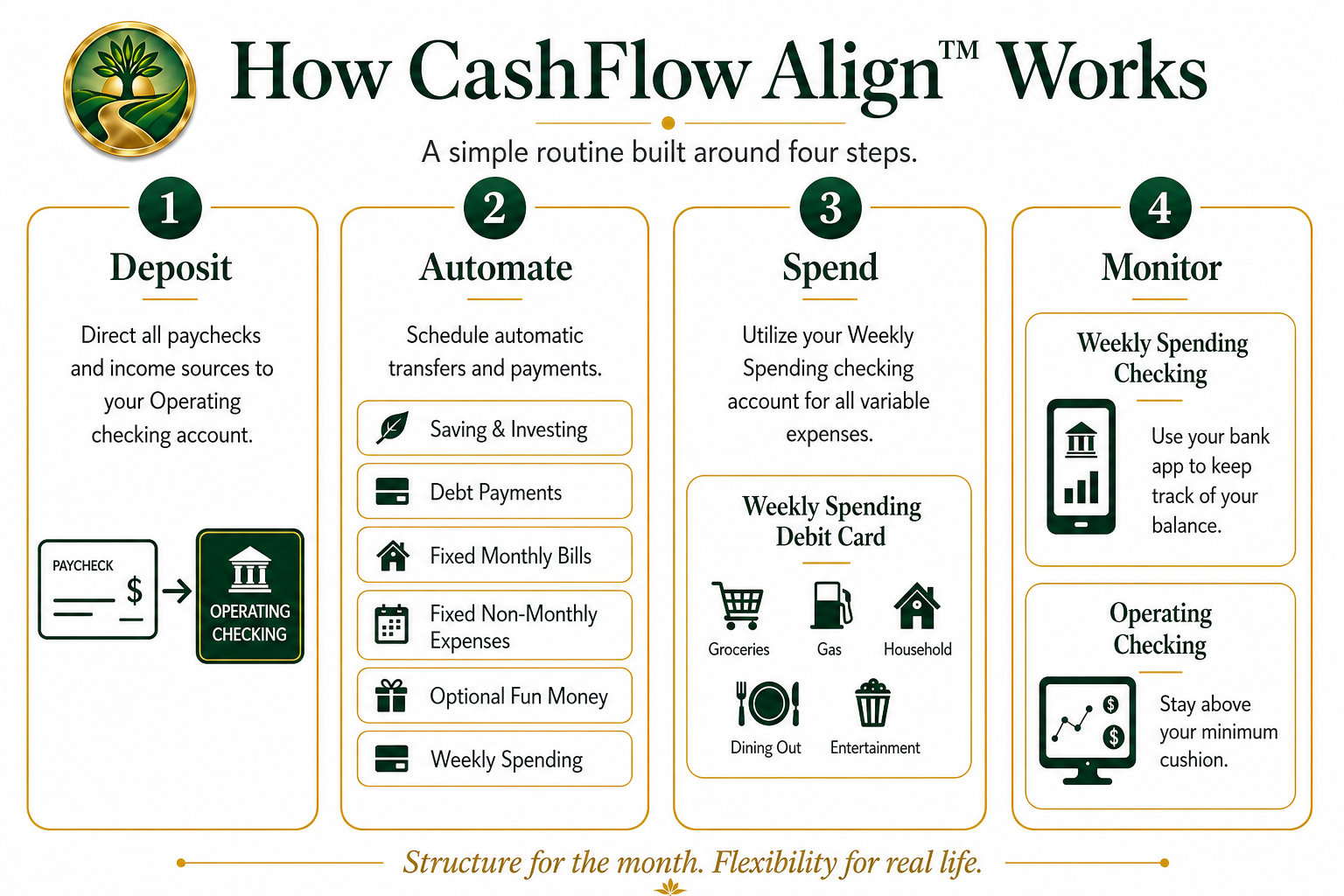
Deposit
Direct all paychecks and income sources to your Operating checking account.
Automate
Schedule automatic transfers and payments.
Spend
Utilize your Weekly Spending checking account for all variable expenses (groceries, gas, household, dining out, entertainment, etc.).
Does this mean you'll need a debit card? Yes. With Apple Pay & Google Pay, it has never been easier to pay securely with your debit card.
Monitor
Take 5 minutes each week to compare your online bank statement to the projected expenses in your Operating checking Timeline.
Utilize your bank app to check the balance in your Weekly Spending checking before making any purchases.
Weekly Spending Transfer
Step 2 · Test the timing
Know the balance before the month begins.
Budgeted deposits, bills, savings transfers, and weekly-spending transfers are already here. Adjust timing or enter actual amounts to keep the Operating checking account healthy throughout the month.
Operating Checking Timeline
Change a timeline day without changing the underlying monthly budget.
| Day | Description | Type | Budget | Actual | Projected Balance | Notes |
|---|